The Morning the Unexpected Demand Notice Arrived for Section 161 GST Rectification
Section 161 GST Rectification became the single most critical legal phrase in Aarav Sharma's life on a crisp Tuesday morning in October. As the founder of Zenith Logistics—a mid-sized fleet management company based out of Pune— Aarav had spent seven years meticulously building his business. His desk was typically covered with route maps and fuel receipts, but today it held a single piece of paper bearing the daunting crest of the Central Goods and Services Tax department.
The document was an assessment order passed under Section 73 of the CGST Act. The bottom line was staggering: a tax demand of ₹45,50,000, accompanied by an equal penalty. Aarav felt his stomach drop. His total tax liability for the financial year had been a mere ₹4,55,000, which Zenith Logistics had paid in full three months prior.
Aarav immediately called his senior tax consultant, Meera Deshmukh. Within forty-five minutes, Meera was sitting across from him, reviewing the order with a sharp, practised eye. Within seconds, her forehead unwrinkled, and a calm smile appeared on her face.
"Look right here, Aarav," Meera said, pointing her pen at paragraph 4 of the order. "The Assessing Officer typed ₹45,50,000 instead of ₹4,55,000. It’s an extra zero added inadvertently during final drafting. This is a classic clerical slip on the face of the record."
Panicked, Aarav asked, "Do we have to file an expensive appeal before the Appellate Authority under Section 107? That will take months and tie up 10% pre-deposit funds!"
"Not at all," Meera replied confidently. "We don't need a lengthy appeal for an obvious slip. We will invoke Section 161 GST Rectification to fix this immediately."
Assessment Order 2. Section 161 Application 3. Rectified DRC-08 (Extra zero added) (Filed within 3 months) (Revised demand)
Demystifying Section 161 GST Rectification
As Meera explained the law over tea, Aarav learned that the Central Goods and Services Tax Act contains built-in safeguards against administrative oversight. Section 161 GST Rectification gives statutory authority to any tax office to correct mistakes that are self-evident from the record itself.
"The law recognises that tax officers are human," Meera noted. "Whether it is an arithmetic oversight, a typographical error, or an accidental omission of a document already submitted on portal records, Section 161 allows the issuing authority to rectify its own order without sending the taxpayer through a gruelling litigation process."
To understand official statutory directives, refer directly to the CBIC Tax Repository Portal for authoritative notifications on statutory compliance under the CGST Act.
What Qualifies as an "Error Apparent on the Face of Record"?
Not every mistake can be handled via Section 161 GST Rectification. Jurisprudential rulings have clearly defined the boundaries of what constitutes an "error apparent on the face of the record."
Key Legal Test for Section 161 GST Rectification:
An error is "apparent on the face of record" if it is plain, manifest, and capable of being identified immediately without long-drawn arguments, complex legal debates, or fresh factual investigations. If proving the mistake requires extensive new testimony or alternative legal interpretations, it falls outside Section 161.
Meera broke down the distinction between rectifiable errors and non-rectifiable disputes for Aarav using a clear taxonomy:
Category of Mistake
Qualifies for Section 161 GST Rectification?
Real-World Example
Arithmetical Slip
YES
Total tax calculation showing ₹ 10,00,000 instead of ₹ 1,00,000 due to addition errors.
Clerical / Typo Error
YES
Inadvertently entering an incorrect GSTIN or wrong financial year (e.g., FY 2021-22 instead of 2022-23).
Ignored Material Record
YES
Tax officer missing a GSTR-3B return copy that was already uploaded and attached prior to order.
Debatable Legal Question
NO (Requires Appeal)
Disputing whether a service qualifies as a "composite supply" vs "mixed supply".
Fresh Evidence/New Facts
NO (Requires Appeal)
Submitting new vendor confirmation letters that were never part of the original proceedings.
For detailed precedent analysis on tax rectifications, legal researchers often consult comprehensive legal repositories like TaxGuru Section 161 Analysis.
Time Limits & Critical Statutory Windows for Section 161 GSTRectification
Time is of the essence when utilising Section 161 GST Rectification. The legislature created strict timelines to ensure finality in administrative tax proceedings while granting sufficient time for correction.
Taxpayer Application Window: An affected taxpayer must submit an application for rectification within 3 months from the date of issuance of the order or notice.
Officer Suo-Moto Limitation: The issuing officer can rectify the order on their own initiative (suo-moto) within 6 months from the issue date
Section 161 GST Rectification vs. Filing an Appeal
Aarav asked the question every business owner faces in a tax dispute: "Why don't we just file an appeal to be completely safe?" Meera highlighted why Section 161 GST Rectification is far superior when an error is obvious.
Parameter
Section 161 GST Rectification
Section 107 Statutory Appeal
Forum / Authority
Same Officer who passed the order; higher appellate
Higher Appellate Authority
Mandatory Pre-Deposit
NIL (₹0)
10% of disputed tax demand
Average Resolution Time
15 to 45 Days 8 to
8 to 18 Months
Legal & Professional Costs
Minimal Substantial
Substantial (Litigation fees)
Scope of Review
Limited strictly to apparent mistakes
Wide review of facts and law
Step-by-Step Filing Strategy for Section 161
To ensure Zenith Logistics obtained swift relief, Meera mapped out a 4-step execution strategy for their Section 161 GST Rectification application:
Step 1: Document Gathering & Error Identification
They extracted the filed GSTR-3B return, the electronic cash ledger summary, and the impugned assessment order. They highlighted the exact clause where ₹4,55,000 was miscopied as ₹45,50,000.
Step 2: Drafting the Rectification Application
Meera drafted a concise application clearly titled "Application under Section 161 for Rectification of Error Apparent on the Face of Record." The draft emphasised that no new facts were being introduced and that the mistake was purely mathematical.
Step 3: Portal Submission & DRC-08 Tracking
The application was uploaded via the GST Common Portal under Services > User Services > Application for Rectification. Upon submission, the portal generated a unique Application Reference Number (ARN).
Step 4: Adherence to Natural Justice
Under Section 161, if a proposed rectification adversely affects any person, the authority must issue a notice and grant an opportunity of being heard. However, since Zenith’s application reduced tax liability, the officer could approve it smoothly without adversarial proceedings.
The Final Resolution & Victory for Zenith Logistics
Three weeks after submitting the online petition, Aarav received an email alert from the GST Portal. The proper officer had reviewed the application, cross-referenced the electronic ledger, and acknowledged the mathematical transposition error. The officer issued a rectified order in Form GST DRC-08, officially reducing the demand from ₹45,50,000 back to the correct amount of ₹4,55,000. Because Zenith Logistics had already paid ₹4,55,000 months prior, the net demand was updated to NIL. Aarav stepped out into the Pune sunlight with immense relief. What could have been a multi-year legal battle with locked capital was resolved in under a month without stepping foot into a courtroom—all thanks to the swift application of Section 161 GST Rectification.
Key Strategic Takeaways for Taxpayers
Every business owner, accountant, and tax professional should keep these core principles in mind when dealing with erroneous tax notices:
Act Immediately: Review every tax order upon receipt. You have a 3-month window to file a Section 161 application.
Verify the Nature of Error: Ensure the mistake is patent and self-evident from the existing record without needing new documents.
Do Not Conflate Review with Rectification: Section 161 cannot be used to re-argue a lost legal dispute or reevaluate evidence.
Monitor Appeal Deadlines: If the 3-month appeal window is closing and the officer has not acted on your rectification application, consider filing a protective appeal under Section 107.
The Midnight Paradox: Rohan’s Story in a 1BHK Mumbai Apartment bed-work-sleep separation India
It was 2:15 AM on a muggy Tuesday morning in Mumbai, India. Rohan lay wide awake, staring up at the shadows dancing across his ceiling. His body was completely exhausted after a 12-hour workday as a software consultant, yet his mind was racing at 100 miles per hour. Standard Western wellness blogs would tell him to practise strict sleep hygiene: "Never bring work into your bedroom. Keep a dedicated home office, and use your bed only for sleep and intimacy."
Rohan let out a quiet, bitter laugh. He lived with his parents and younger sister in a tight 1BHK apartment in Lower Parel. His "dedicated home office" was the same wooden double bed he had slept on since high school. During the day, that bed served as his office desk, his dining table, his video conference studio, and his evening lounging couch. By the time midnight rolled around, his brain was so profoundly confused that it no longer knew whether lying down meant preparing for deep restorative REM sleep or bracing for an urgent Slack ping from a client in London.
Rohan’s struggle is not an isolated case. Across metropolitan hubs like Bengaluru, Delhi-NCR, Pune, and Chennai, millions of young professionals and students face the exact same architectural challenge. Traditional sleep advice assumes an abundance of square footage that simply does not exist in urban India. When your living room is also your family’s TV room and your kitchen doubles as a transit corridor, your bed becomes the sole flat sanctuary where you can sit quietly with a laptop. However, failing to establish proper bed, work, and sleep separation in India comes at a severe cognitive and physiological cost.
"When you turn your bed into an office, your brain treats your pillow as an alert workstation. You don't suffer from medical insomnia; you suffer from spatial association overload."
According to clinical sleep research published by the National Sleep Foundation, Pavlovian classical conditioning governs our sleep-wake cycles far more than most people realise. When you repeatedly sit on your mattress to debug code, compile financial spreadsheets, or debate project deadlines, your nervous system releases cortisol and norepinephrine in that exact physical spot Over time, the physical stimulus of touching your mattress activates your sympathetic nervous system—the "fight or flight" mechanism—rather than the parasympathetic "rest and digest" state necessary for falling asleep fast.
Why Your Brain is Confused: The Neuroscience of Pavlovian Sleep Triggers
To fix a broken sleep architecture, we must first understand the underlying neuroscience of habits and environmental cues. Ivan Pavlov famously demonstrated that dogs could be conditioned to salivate at the sound of a metronome if that sound was repeatedly paired with food. Human brains operate on the exact same associative neural networks. Every physical space you inhabit sends a subtle, automatic command to your brain regarding what neurochemicals it should release.
When you sit in a dedicated corporate boardroom, your brain elevates dopamine and arousal to foster analytical focus. When you enter a dim, quiet spa, your brain drops muscle tension and reduces heart rate. What happens when your bedroom is forced to perform four conflicting functions simultaneously?
When you execute bed-work-sleep separation India strategies, you break this destructive neurological loop. You do not need to buy a lavish 3BHK penthouse or rent an expensive co-working desk in Indiranagar. What you need is a systematic, ritualised method to signal to your brain when the bed is a high-arousal workstation and when it transitions into an untouchable sleep sanctuary. Exploring comprehensive health insights on Healthline Medical Review confirms that environmental stimulus control is the single most effective non-pharmacological treatment for sleep latency.
The Reality of Indian Households: Living in Compact, Shared Spaces
Western ergonomic literature routinely suggests buying a motorised standing desk, setting up dual 27-inch 4K monitors, and isolating yourself in a soundproof home library. For the vast majority of Indians residing in joint families, shared PG accommodations, or studio apartments, these recommendations are totally out of touch with reality.
Consider the typical daily environment:
Acoustic Overlap: Pressure cookers whistling in the kitchen, street vendors calling out, and family members watching news in the adjacent hall.
Spatial Constraints: A single bedroom measuring 10x10 feet, where adding a dedicated study desk would completely block the wardrobe door or balcony access.
Thermal Comfort Factors: The air conditioner or ceiling fan is positioned directly over the bed, making the mattress the coolest, most comfortable spot during scorching summer months.
Because of these real-world constraints, telling an Indian professional to "just stop sitting on your bed" results in guilt and immediate failure. Instead, our framework focuses on micro-zoning and sensory shifting. If you must physically sit on your bed to work, you must change the texture, orientation, lighting, and posture so that your brain registers two completely different environments on the exact same mattress.
The 7-Step Protocol for Bed Work Sleep Separation in India
Here is the exact, battle-tested 7-step blueprint designed specifically for high-stress Indian professionals living in compact apartments.
Step 1: The Day Bed vs. Night Bed Transformation (The Surface Overlay Rule)
Never let your bare bedsheets or nighttime blanket touch your work setup. In the morning, make your bed with military precision. Lay down a specific, heavy, dark-coloured bedspread or thick cotton yoga mat over your sheet. This "Work Mat" becomes your designated office floor. When your body sits on this distinct texture, it signals daytime productivity. At 7:00 PM, fold this work mat away completely. The physical reveal of your soft, pristine white bedsheet acts as an instant psychological trigger for relaxation.
Human spatial awareness is highly directional. When you sleep, your head rests on your pillow facing north or east. When you work on your bed, sit at the opposite end or turn your back entirely against the headboard. Lean against a firm lumbar support wedge pillow placed at the foot of the bed. By shifting your visual field 180 degrees, your eye line captures different wall angles and lighting, preventing your brain from associating your sleeping position with work stress.
Step 3: The Portable Lap Desk Barrier
Lying flat on your stomach with a laptop propped on a soft pillow destroys both your neck posture and your sleep hygiene. Invest in a foldable wooden lap desk with adjustable-height legs. This creates an elevated, firm physical boundary between your lap and the bed surface. When the lap desk is set up, you are officially in "Office Mode". When you fold the legs and slide it under the bed, "office mode" is physically destroyed for the night.
Step 4: Lighting Temperature Protocol (4000K to 2200K Shift)
Light intensity and colour temperature directly regulate melatonin production in the pineal gland. During work hours on your bed, turn on bright cool white lighting (4000K–6500K) to suppress melatonin and keep your alertness at its peak. The moment work ends, switch off overhead tube lights completely. Switch to a warm amber bedside lamp (2200K) or a low-wattage warm LED strip. This dramatic shift in visual atmosphere enforces effective bed-work-sleep separation even in a single-room home.
Step 5: The Tactile Work Uniform (Ditch the Pyjamas)
Working in the exact same soft cotton pyjamas that you slept in creates extreme cognitive blur. Establish a strict dress code. Put on structured clothes—such as a collared polo shirt, jeans, or formal shorts—before touching your laptop on the bed. When your work session finishes, change into your dedicated night sleepwear. This physical ritual acts as a sensory boundary that separates professional stress from personal rest.
Step 6: Digital Boundary Partitioning
If you use the same laptop or tablet for both work and personal entertainment on your bed, create two distinct user profiles on your operating system. Your "Work Profile" should feature a dark, minimalist productivity wallpaper with all social media apps blocked. Your "personal profile" should have a relaxing, warm wallpaper with Slack, Microsoft Teams, and work email clients completely disabled. This prevents accidental work notifications from invading your evening wind-down time.
Step 7: The "Shutdown Sequence" Buffer Ritual
You cannot instantly switch off a hyperactive brain after staring at a spreadsheet at 11:00 PM. Implement a mandatory 30-minute buffer ritual. Close all work tabs, shut down your laptop, place it inside a bag or drawer out of sight, and step off the bed completely. Spend 15 minutes drinking a warm cup of herbal chamomile tea, practising light stretching on the floor, or reading a non-fiction paperback before re-entering the bed for actual sleep.
Environmental & Sensory Anchors: Reprogramming Your Mind
To reinforce your micro-zone boundaries, leverage olfactory and auditory anchors. Our olfactory bulb has a direct neural link to the amygdala and hippocampus, making scent one of the fastest ways to alter emotional and physiological states.
By systematically applying these sensory anchors, Rohan transformed his single wooden bed into two distinct psychological environments. Within three weeks of implementing the bed work-sleep separation India protocol, his sleep onset latency dropped from 90 agonising minutes down to less than 15 minutes per night. His energy levels skyrocketed, and his workday productivity surged because his brain finally knew when to focus and when to relax.
Summary & Key Takeaways for High Performers
Core Takeaways for Small Space Optimization
Spatial Association is King: Your brain bonds environments with emotional states. A confused space leads to an anxious mind.
Micro-Zoning Works: You don't need extra rooms; you need distinct physical overlays, directional shifts, and lighting temperatures.
Consistency is Crucial: Practise the 7-step protocol daily for at least 21 days to fully overwrite existing Pavlovian sleep habits.
For further reading on optimising your mental productivity and habit formation frameworks, explore our internal resources on DareMinds Mindset & Productivity Systems and learn how micro-habits compound into extraordinary personal transformation.
Feeling overwhelmed by financial stress? Discover how financial therapy in India can help you break money avoidance, process debt shame, and build wealth effortlessly.
Introduction: The Emotional Burden of Money
Financial Therapy India is quickly becoming a critical conversation for working professionals, entrepreneurs, and families across the country.
Imagine logging into your banking app late at night. Before the dashboard even loads, your chest tightens. A sudden wave of anxiety hits you as you wait for the balance to appear.
Whether your bank account holds ₹50,000 or ₹5,000,000, that visceral dread is identical. Money is rarely just a set of digits on a screen. It is tied directly to our survival instincts, self-worth, family security, and deeply held fears of failure.
When financial stress peaks, conventional advice always focuses on technical mechanics:
"Cut down on non-essential dining out."
"Increase your equity mutual fund SIP allocations by 10%."
"Build a strict 6-month liquid emergency reserve."
"Track every rupee using an automated budgeting app."
While mathematically sound, this advice overlooks a basic human truth: You cannot cure an emotional or psychological money problem using purely technical tools.
If reviewing your bank statements triggers physical panic or shame, an Excel spreadsheet will not solve the issue. This is precisely why exploring Financial Therapy India offers a transformative path forward
What Is Financial Therapy India?
Financial therapy is an integrative discipline operating at the exact intersection of clinical mental health and strategic wealth planning.
Rather than focusing solely on stock picks or basic budgeting, financial therapy examines how your emotions, past trauma, cognitive patterns, and family upbringing shape your financial decisions.
PSYCHOLOGICAL WELL-BEING
PRACTICAL EXECUTION
Money Anxiety
Asset Allocation
Avoidance
Automated SIPs
Debt Shame
Debt Paydown
Scarcity Fear
Emergency Cash
The 4 Core Money Scripts
In financial therapy practices in India, professionals look closely at subconscious belief systems—often called "money scripts"—that dictate human behaviour:
Money Avoidance: Believing money is inherently stressful or corrupting. This leads to procrastinating on tax filings, ignoring credit card bills, and avoiding account balances.
Money Worship: Believing more money will instantly eliminate all emotional suffering and insecurity. This leads to chronic overworking and chasing high-risk investments.
Money Status: Equating self-worth directly with net worth. This drives lifestyle inflation, heavy EMI burdens, and conspicuous luxury consumption.
Money Vigilance: Feeling constant alertness, secrecy, and fear around money, even with ample reserves. This results in intense guilt over necessary daily expenses.
The Regulatory Divide: Why No Single Credential Exists
If you search online directories for a licensed professional in financial therapy in India, you will quickly encounter a legal and regulatory reality: India does not have a single, unified credential combining financial advice and clinical psychotherapy.
INDIA'S DUAL REGULATORY LANDSCAPE
FINANCIAL SILO (SEBI / FPSB)
HEALTHCARE SILO (RCI / Medical)
Regulates:
Portfolio Advice
Clinical Care
Asset Allocations
Psychotherapy
Wealth Planning
Mental Health
CANNOT offer/recommend
therapy or mental health treatments.
Specific stocks, funds, or advice.
Silo 1: Financial Advisory (SEBI & FPSB)
The Securities and Exchange Board of India regulates financial advice. An adviser registered with SEBI or certified by FPSB India understands asset allocation, tax efficiency, and portfolio risk.
However, financial advisers are legally and ethically barred from offering clinical psychotherapy or mental health diagnoses.
Silo 2: Healthcare & Mental Health (RCI & Medical Boards)
Clinical psychologists and counsellors are trained in emotional regulation, cognitive behavioural therapy (CBT), and trauma recovery.
However, therapists cannot legally recommend specific mutual funds, structure equity portfolios, or manage tax strategies.
The Master Comparison Table of Resources
Because no single practitioner holds both regulatory licences, understanding how to navigate available professional resources in India is essential:
Resource Category
Primary Focus & Scope
What It Cannot Do
Verification Link
SEBI-Registered Investment Adviser (RIA)
Regulated investment management, fiduciary asset allocation, and goal planning.
Cannot treat psychological trauma, money anxiety, or compulsive habits.
Treats mental health mechanics: chronic money anxiety, shame, avoidance, and stress.
Cannot give stock picks, select mutual funds, or design tax plans.
Consult clinical registries or verified mental health networks.
Step-by-Step: The Two-Pillar Healing Framework
To overcome the lack of a single unified credential, adopt a two-pillar framework for financial therapy India requirements.
THE TWO-PILLAR HEALING STRATEGY
PILLAR 1: EMOTIONAL WORK
PILLAR 2 TECHNICAL WORK
Provider:
Licensed Therapist
SEBI RIA / CFP
Focus:
Calm Anxiety
Automated SIPs
End Avoidance
Asset Allocation
Address Shame
Risk Shielding
=====> TRANSITION ======>
When emotions settle, engage the technical financial architecture.
Pillar 1: Calming the Nervous System
When money anxiety is high, sitting down with a financial advisor often leads to overwhelm. You may receive an excellent wealth plan, but emotional avoidance will stop you from acting on it.
Start by working with a mental health counsellor to process emotional barriers, stop avoidant behaviours, and build healthy coping mechanisms.
Pillar 2: Building Technical Architecture
Once your nervous system is calm, transition to a fee-only CFP or SEBI RIA.
At this stage, you can execute stress-free systems:
Automated monthly SIPs running on payday.
Separate, high-grade liquid emergency funds.
Adequate term and health insurance shields.
Check out our related internal guide on Building an Automated Emergency Fund Framework for step-by-step account structures.
Case Study: Recovering from High-Risk Trading Losses
After losing savings in volatile trades, an investor often experiences:
Deep Shame: Secrecy and hiding losses from family members.
Avoidance: Refusing to open banking apps or review account balances.
Panic Trades: Impulsively taking bigger risks to "win back" capital.
The Hybrid Recovery
Pillar 1: The investor works with a counsellor to process grief, break the cycle of secrecy, and calm market-related anxiety.
Pillar 2: The investor engages a fee-only planner to set up automated index fund SIPs that build wealth quietly without requiring daily market tracking.
How to Screen Professionals for Financial Therapy in India
Asking targeted questions helps identify the right support for your needs.
Questions for a Mental Health Therapist
"Do you have experience working with clients dealing with money anxiety, debt stress, or financial avoidance?"
"How do you incorporate money-related stress into cognitive behavioural therapy (CBT) sessions?"
Questions for a Financial Adviser
"Are you a SEBI-Registered Investment Adviser or Fee-Only CFP, and what is your official registration number?"
"Do you earn any product commissions or referral payouts from fund houses?"
For further reading on verifying adviser credentials, review our internal analysis on How to Choose a Fee-Only CFP in India.
Self-Diagnostic Checklist & Next Steps
Use this decision tool to identify your immediate starting point:
WHAT IS YOUR PRIMARY BARRIER TO FINANCIAL PROGRESS?
EMOTIONAL / PSYCHOLOGICAL
Panic / Anxiety
SEEK: Licensed Mental Health Counsellor
Account Avoidance
Deep Shame/Guilt
Impulsive Spends
TECHNICAL / INFORMATIONAL
Unsure where to invest
SEEK: SEBI RIA or Fee-Only CFP
Cluttered funds
Tax optimization
Summary of Action Steps
Identify the core issue: Determine whether your main barrier is emotional anxiety or technical planning.
Address emotional noise first: Consult a mental health counsellor to overcome avoidance and shame.
Build automated structures: Work with a SEBI RIA or fee-only CFP to design hands-off wealth systems.
By combining emotional healing with systematic wealth planning, you can achieve true financial peace.
Disclaimer: This guide is for educational purposes only. If financial stress is severely impacting your mental health, please consult a licensed mental health professional. For portfolio design, consult a SEBI-registered investment adviser.
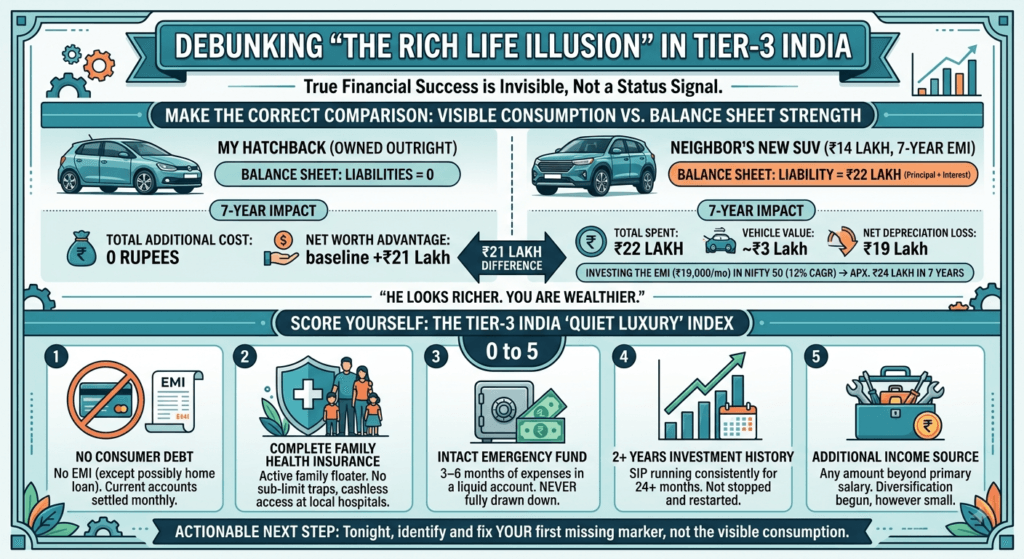
The rich-life illusion in an Indian tier-3 city: Creta next door isn't wealth. It's a 7-year EMI with a depreciation clock. Here's the correct comparison – and the quiet luxury index for tier-3 India.
Disclaimer: This article contains affiliate links to investment platforms such as Zerodha and Dhan. We are not SEBI-registered advisors; please consult a qualified financial professional.
The Comparison That Made Me Feel Poor When I Wasn't A Rich Life Illusion
My neighbour bought a new Hyundai Creta in March.
14 lakh rupees ex-showroom. Seven-year loan at approximately 9% interest—monthly EMI: approximately 19,000 rupees.
For approximately two weeks after the Creta appeared in the shared parking, I had a persistent low-grade feeling of financial inadequacy.
My own vehicle -- a 2017 hatchback owned outright -- looked older by comparison. The visible gap in consumption felt like a gap in financial standing.
Then I ran the actual comparison. Not consumption versus consumption -- that comparison is what produces the inadequacy feeling. Balance sheet versus balance sheet -- which is the comparison that tells the truth.
"The feeling of being less wealthy and the reality of having less wealth are two completely different things. One is produced by visible consumption comparison. The other requires a balance sheet."
The Creta Balance Sheet — The Number Most People Never Run — which is a rich-life illusion.
ITEM
CRETA BUYER (7-YEAR EMI)
MY HATCHBACK (OWNED)
Monthly outflow
Rs 19,000 EMI
Rs. 0 (running cost only)
Total paid over 7 years
~Rs 22 L (purchase + interest)
Rs. 0 additional capital outlay
Vehicle value at year 7
~Rs 3-4 Lakh
~ Rs 1 Lakh (older)
Net asset created
Rs 3-4 L from Rs 22 L spent
Rs. 0 additional expense
EMI capital invested in Nifty 50 instead
N/A
Rs 24 L is the same monthly amount for 7 yr, 12% CAGR
Net worth difference at year 7
Baseline
+ Rs 21-22 L advantage
The table's most important row: if the Rs 19,000 monthly EMI were instead directed to a Nifty 50 SIP for 7 years at 12% CAGR, the terminal value would be approximately Rs 24 lakh. The vehicle's value at the same point: approximately Rs 3 lakh.
The wealth difference between the two approaches, measured at the 7-year mark: approximately Rs 21 lakh. This is not an argument against car purchases. Cars serve real purposes: reliability, safety, productivity, family transport, professional credibility.
The Creta is a sensible family vehicle. The argument is against using the visible quality of someone else's car as a proxy for their wealth. The Creta signals income and expenditure.
It says nothing about net worth, emergency fund, investment history, or insurance coverage.
Why Visible Consumption Is poor wealth compared to rich life Illusion Proxy in India
Thorstein Veblen's concept of conspicuous consumption -- spending to signal status -- was developed in the context of a society where the wealthy could afford to signal status and the non-wealthy could not. The signal had content: visible consumption implied underlying wealth.
Consumer credit has largely invalidated this relationship. EMI financing means that the visible consumption signal can be purchased on credit by anyone with a stable income -- regardless of their actual wealth position.
The person with a new SUV on a 7-year EMI and no emergency fund is making a different financial choice than the person with a paid-off older vehicle and a growing SIP portfolio.
But from the street, they are indistinguishable -- and from the street comparison, the SUV owner appears wealthier.
In tier-3 India specifically, where consumer credit has expanded significantly in the last decade, investment culture has grown more slowly, widening the gap between visible consumption and actual wealth.
The position is particularly wide. The neighbourhood's newest vehicles frequently represent the highest debt loads, not the highest net worths
If that same ₹19,000 monthly outflow were redirected into an index fund via platforms like Zerodha or Dhan, it would grow into approximately ₹24 lakh at a 12% CAGR over 7 years.
The Rich Life Illusion: Quiet Luxury Index — Five Markers for Tier-3 India
Quiet luxury, in the global personal finance context, refers to the wealth signals invisible to casual observation. In tier-3 India, those signals are specific:
MARKER
WAHTIT LOOK LIKE
WHAT IT SIGNALS
1. No consumer debt
Zero EMIs (except possibly a home loan); credit card balances cleared monthly
Positive cash flow without consumption leverage.
2. Family health insurance
Active family floater or individual policy with no sub-limit traps or gaps.
Medical emergencies will not wipe out accumulated capital.
3. Emergency fund intact
3–6 months of living expenses in a liquid account, never fully drawn down.
Short-term financial shocks are absorbed without resorting to debt.
4.2+ years investment history
SIP running consistently for 24+ consecutive months.
Active compounding and established financial discipline.
5. One additional income source
At least one additional income stream beyond the primary salary, however small.
Early diversification and reduced single-employer dependency.
Score 0 to 5 -- one point per confirmed marker.
SCORE
POSITION
PRIORITY ACTION
0
Financial foundation not yet started
Start emergency fund first — any amount
1
Beginning — one foundational element in place
Health insurance if missing; emergency fund if no insurance
2
Building — two elements established
Their marker — usually consistent investment history
3
Stable foundation
Fourth or fifth marker — usually additional income or extended emergency fund
4
Strong foundation
Optimise existing — increase SIP, extend emergency fund to 6 months
5
Tier-3 quiet luxury position
Maintain and compound — the foundation is established
The Creator's Score — Honest Accounting for rich life Illusion
At the time of the Creta comparison, my quiet luxury score was 3.
Marker 1 — No consumer debt: yes. No EMI, no credit card balance.
Marker 2 — Health insurance: partial. Individual policy in place, but not a family floater.
Marker 3 — Emergency fund intact: yes. Four months of expenses, not drawn down.
Marker 5 — Additional income: early stage. DareMinds' income is beginning but not yet stable.
My estimated score for the Creta neighbour: 1 to 2. Income: yes (one point by definition). Emergency fund: Uncertain -- the Rs 19,000 monthly EMI significantly constrains emergency fund building.
Health insurance: unknown. No consumer debt: no -- the Creta loan is consumer debt. The feeling is that he is wealthier. The score: I am in a stronger position. The Creta is a consumption signal, not a wealth signal.
Recalibrating the Reference Group for the rich life Illusion
The quiet luxury score is useful beyond its function as a self-assessment tool.
It provides a recalibrated reference group -- a way to compare financial positions against dimensions that actually predict long-term wealth rather than current consumption visibility.
The NSSO and PLFS data on Indian household income and wealth distribution provide the broader Context:
Monthly Household Income
Approximate Income Percentage
Context
< Rs 10,000
< 40th percentile
Below median — majority of Indian households
Rs 20,000
~65th percentile
Above median
Rs 30,000
~75th percentile
Top quarter
Rs 50,000
~88th percentile
Top 12%
Rs 100,000
~95th percentile Top
Top 5%
The reference group visible on social media and in professional networks is not representative of India's income distribution. LinkedIn's feed is populated by the top 5 to 10% of earners -- the Rs 1 lakh+ households.
The neighbour's Creta represents the top 12 to 15% of households by income. Comparing one's financial position to these visible reference points and feeling inadequate is comparing against a systematically unrepresentative sample.
The percentile look-up -- available through NSSO data -- provides the accurate comparison: at Rs With a Rs 30,000/month household income, you are in the top quarter of Indian households by income.
The Creta: The comparison is between one top-quarter household and another.
Neither is 'rich' by global standards. Both are in a strong position by Indian standards. The EMI structure of one does not make it wealthier than the other.
What is your quiet luxury score tonight as a rich-life illusion?
Five questions. One point each.
Is your current financial position free of consumer debt (no EMIs except possibly a home loan)?
Do you have health insurance covering yourself and any dependants, currently active, with no significant gap?
Do you have an emergency fund of at least 3 months of expenses that has not been emptied in the last 12 months?
Have you had a consistent investment (SIP or equivalent) running for at least 24 months without stopping?
Do you have any income source beyond your primary salary, however small?
Write your score. The first missing marker is your next financial action. Not the Creta. The marker.
If comparison anxiety is keeping you awake, use the 5-minute financial dump from Why You Wake Up at 3 AM or apply the tactile sleep protocols from Military Sleep Method to clear active memory before bed.
Cross-Generational Workplace friction isn't a genuine values conflict — it's two different communication dialects being mistaken for two different sets of values. The specific translation that resolves much of it.
Why Generational Friction Is Frequently Misread as a Values Conflict in the Cross-Generational Workplace
Different generations of the workforce typically learned different default communication norms — distinct expectations around formality, directness, and what specific signals count as respectful versus disrespectful. A substantial share of what gets labelled 'generational conflict' actually reflects a dialect mismatch rather than a genuine disagreement about underlying values such as respect or diligence, since both parties frequently hold the same underlying value while expressing it through different learned signals.
"Two people can both genuinely value punctuality while having learned different specific thresholds for what punctuality looks like in practice. Neither disrespects the value — they just learned different dialects for expressing it, and each reads the other's behaviour through their own dialect's rules."
The Translation Check Surface for Cross-Generational Workplace
Surface behaviour
Possible dialect translation
A message with no greeting, straight to the point.
Efficiency and respect for the reader's time, not curtness.
A long, formal message with extensive context.
Thoroughness and respect for getting it right, not inefficiency.
Immediate, casual pushback on an idea.
Engagement and directness, not disrespect for authority
Careful, indirect disagreement
Respect for hierarchy and relationships, not evasiveness
The operative question before reacting to apparent generational friction: is there a values-respecting interpretation of this behaviour, from the other person's likely communication dialect, that has not yet been considered? Applying this check before assuming negative intent resolves a meaningful share of situations that initially present as genuine generational conflict.
A Documented Application
Building the DareMinds audience across different age groups surfaced genuinely different response styles to identical content — some viewers engaging through long, formal comments and others through short, blunt reactions that could, read through a single lens, appear dismissive. Applying the translation check to the short, blunt responses specifically revealed genuine engagement expressed through a dialect valuing brevity over elaboration, rather than actual dismissiveness. This recalibration extended beyond comment interpretation to professional communication generally – checking for a values-respecting translation before assuming friction, rather than defaulting to whichever interpretation happened to align with a single, personally familiar dialect's specific norms.
Applying This to Your Own Next Friction Point
When a cross-generational workplace interaction produces a sense of friction, run the translation check before reacting. Search for a values-respecting interpretation within the other person's likely communication dialect before concluding that the surface behaviour reflects an actual, underlying values conflict.
** Not SEBI registered. Personal financial documentation only. Consult a qualified professional before investing.
** Not SEBI Registered. All content is for personal financial decisions only. Consult a qualified professional before investing. Affiliate disclosure: commission earned at no cost to the reader.
"The Boring Middle: Most people don't fail because they aren't talented. They fail because they mistake invisible progress for no progress."
What Is the Boring Middle?
The Boring Middle is the long stretch between the excitement of starting something new and the satisfaction of finally seeing meaningful results.
It isn't failure.
It isn't success.
It's the quiet period where your efforts feel repetitive, your motivation fades, and nothing around you seems to suggest you're getting closer to your goal.
Ironically, this is also where the majority of meaningful progress happens.
Whether you're building a business, preparing for competitive exams, learning a new skill, growing your investments, or trying to improve your health, almost every worthwhile journey has a boring middle.
The problem is that very few people talk about it.
Social media celebrates beginnings.
Everyone posts the launch.
Everyone celebrates the breakthrough.
Almost nobody documents the hundreds of ordinary days in between.
Those ordinary days are where success is quietly built.
The Day I Almost Quit: As the boring middle
When I started working on DareMinds, everything felt exciting.
Every new article felt like a milestone.
Every idea felt revolutionary.
Every visitor on the website felt like proof that I was moving in the right direction.
Then something changed.
The excitement slowly disappeared.
The work didn't.
Every week looked almost identical.
Research.
Writing.
Editing.
Publishing.
Learning SEO.
Improving headlines.
Studying psychology.
Reading books.
Repeating the process.
Weeks turned into months.
The website wasn't exploding with traffic.
There wasn't a viral article.
No sudden breakthrough.
If someone had looked from the outside, they might have thought nothing was happening.
From the inside, it felt even worse.
It felt like I was running on a treadmill.
Moving constantly.
Going nowhere.
There were days I genuinely questioned whether I was wasting my time.
Maybe I wasn't good enough.
The idea wasn't strong enough.
Maybe I should start something else.
That feeling is surprisingly common.
And it's exactly why so many promising careers, businesses and creative projects never reach their potential.
Not because people fail.
Because they leave during The Boring Middle.
Why The Boring Middle Feels So Difficult
Human beings aren't naturally designed to enjoy delayed rewards.
Our brains evolved to prioritise immediate feedback because immediate feedback helped our ancestors survive.
Finding food produced an instant reward.
Escaping danger produced instant relief.
But modern achievements rarely work that way.
Learning to program doesn't pay off after one lesson.
Building a company doesn't reward you after one month.
Writing a book doesn't reward you after one chapter.
Investing doesn't reward you after one SIP.
The rewards are delayed.
And delayed rewards confuse the brain.
When effort and reward are separated by weeks, months or years, motivation naturally starts declining.
That doesn't mean you're making no progress.
It simply means your brain can't easily see it.
Psychologists call this a challenge of delayed reinforcement—when the payoff arrives long after the work. It's one reason consistency feels much harder than starting something new.
Research on habit formation and sustained performance has shown that people are more likely to continue when they notice even small signs of progress. Teresa Amabile's work on The Progress Principle found that tiny wins can have a surprisingly powerful effect on motivation.
The problem?
Many of those wins are invisible unless you intentionally look for them.
The Airplane That Changed My Perspective from the boring Middle
Imagine you're sitting on a twelve-hour international flight.
Takeoff is exciting.
You feel acceleration.
You watch the city disappear beneath the clouds.
Landing is exciting too.
The anticipation returns.
The destination is finally within reach.
But what about the nine hours in between?
Nothing dramatic happens.
You stare out of the window.
The clouds barely change.
The cabin feels motionless.
Yet while everything feels still, the aircraft is covering hundreds of kilometres every single hour.
Your perception says, "Nothing is happening."
Reality says, "You're making enormous progress."
Life works the same way.
Most careers don't grow during dramatic moments.
They grow during ordinary Tuesdays.
The presentation nobody applauds.
The article nobody shares.
The workout nobody notices.
The chapter nobody compliments.
The investment that quietly compounds.
The conversation that subtly improves your communication skills.
The boring middle isn't empty.
It's where distance is covered.
Affiliates
The boring middle isn't limited to careers. Investing works the same way. Most wealth isn't created by finding the next hot stock but by staying invested consistently over years. If you're starting your investment journey, platforms like Zerodha make it easy to begin with SIPs, index funds, and long-term investing.
If you're a more active investor who tracks markets, analyses stocks, or trades regularly, Dhan provides advanced charting and trading features that complement a disciplined investing approach.
Success isn't built during moments of excitement—it's built during the boring middle, when you keep showing up even though the results haven't shown up yet.
Disclosure: Some links in this article are affiliate links. If you sign up through them, I may earn a commission at no extra cost to you. I only recommend products and services I genuinely believe provide value.